Skip to content

Next.js + MongoDB Connection Storming

Next.js + MongoDB Connection Storming

Building a Next.js application connected to MongoDB can feel like a match made in heaven. MongoDB stores all of its data as JSON objects, which don’t require transformation into JavaScript objects like relational SQL data does. However, when deploying your application to a serverless production environment such as Vercel, it is crucial to manage your database connections properly.

If you encounter errors like these, you may be experiencing Connection Storming:

  • MongoServerSelectionError: connect ECONNREFUSED <IP_ADDRESS>:<PORT>
  • MongoNetworkError: failed to connect to server [<hostname>:<port>] on first connect
  • MongoTimeoutError: Server selection timed out after <x> ms
  • MongoTopologyClosedError: Topology is closed, please connect
  • Mongo Atlas: Connections % of configured limit has gone above 80

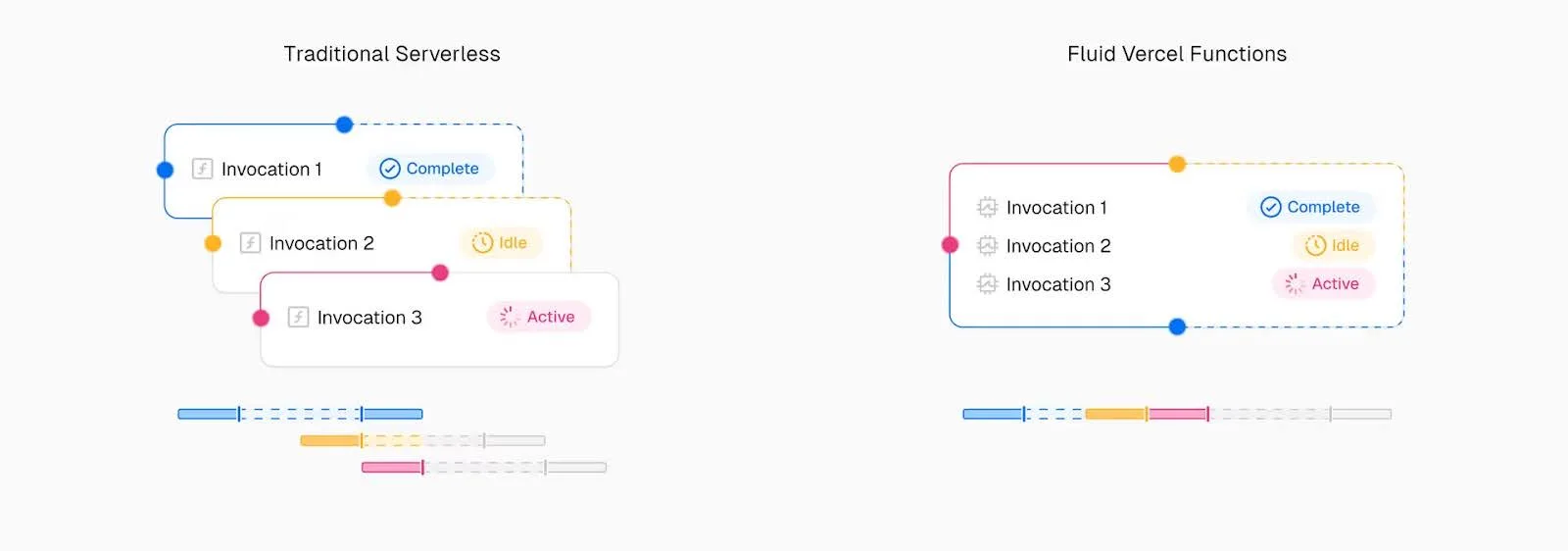
Connection storming occurs when your application has to mount a connection to Mongo for every serverless function or API endpoint call. Vercel executes your application’s code in a highly concurrent and isolated fashion. So, if you create new database connections on each request, your app might quickly exceed the connection limit of your database.

We can leverage Vercel’s fluid compute model to keep our database connection objects warm across function invocations. Traditional serverless architecture was designed for quick, stateless web app transactions. Now, especially with the rise of LLM-oriented applications built with Next.js, interactions with applications are becoming more sequential. We just need to ensure that we assign our MongoDB connection to a global variable.

unnamed

Protip: Use global variables

Vercel’s fluid compute model means all memory, including global constants like a MongoDB client, stays initialized between requests as long as the instance remains active. By assigning your MongoDB client to a global constant, you avoid redundant setup work and reduce the overhead of cold starts. This enables a more efficient approach to reusing connections for your application’s MongoDB client.

The example below demonstrates how to retrieve an array of users from the users collection in MongoDB and either return them through an API request to /api/users or render them as an HTML list at the /users route. To support this, we initialize a global clientPromise variable that maintains the MongoDB connection across warm serverless executions, avoiding re-initialization on every request.

// lib/mongodb.ts
import { MongoClient, Db } from 'mongodb';

if (!process.env.MONGODB_URI) {
  throw new Error('Invalid/Missing environment variable: "MONGODB_URI"');
}

const clientPromise: Promise<MongoClient> = (async () => {
  const client = new MongoClient(process.env.MONGODB_URI!);
  const connectedClient = await client.connect();
  console.log('✅ MongoDB connection established');
  return connectedClient;
})();

export async function getDatabase(): Promise<Db> {
  const client = await clientPromise;
  return client.db('testing_db');
}

Using this database connection in your API route code is easy:

// src/app/api/users/route.ts
import { NextResponse } from 'next/server';
import { getDatabase } from '@/lib/mongodb';

export async function GET() {
  const db = await getDatabase();
  const collection = db.collection('users');
  const users = await collection.find({}).toArray();
  return NextResponse.json({ users });
}

You can also use this database connection in your server-side rendered React components.

// src/app/users/page.tsx
import { getDatabase } from '@/lib/mongodb'

export default async function UserList() {
  const db = await getDatabase()
  const collection = db.collection('users')
  const users = await collection.find({}).toArray()

  return (
    <div>
      <h1>Users List</h1>
      <ul>
        {users.map((user) => (
          <li key={user._id.toString()}>{user.name}</li>
        ))}
      </ul>
    </div>
  )
}

In serverless environments like Vercel, managing database connections efficiently is key to avoiding connection storming. By reusing global variables and understanding the serverless execution model, you can ensure your Next.js app remains stable and performant.

This Dot is a consultancy dedicated to guiding companies through their modernization and digital transformation journeys. Specializing in replatforming, modernizing, and launching new initiatives, we stand out by taking true ownership of your engineering projects.

We love helping teams with projects that have missed their deadlines or helping keep your strategic digital initiatives on course. Check out our case studies and our clients that trust us with their engineering.

You might also like

Vercel BotID: The Invisible Bot Protection You Needed cover image

Vercel BotID: The Invisible Bot Protection You Needed

Nowadays, bots do not act like “bots”. They can execute JavaScript, solve CAPTCHAs, and navigate as real users. Traditional defenses often fail to meet expectations or frustrate genuine users. That’s why Vercel created BotID, an invisible CAPTCHA that has real-time protections against sophisticated bots that help you protect your critical endpoints. In this blog post, we will explore why you should care about this new tool, how to set it up, its use cases, and some key considerations to take into account. We will be using Next.js for our examples, but please note that this tool is not tied to this framework alone; the only requirement is that your app is deployed and running on Vercel. Why Should You Care? Think about these scenarios: - Checkout flows are overwhelmed by scalpers - Signup forms inundated with fake registrations - API endpoints draining resources with malicious requests They all impact you and your users in a negative way. For example, when bots flood your checkout page, real customers are unable to complete their purchases, resulting in your business losing money and damaging customer trust. Fake signups clutter the app, slowing things down and making user data unreliable. When someone deliberately overloads your app’s API, it can crash or become unusable, making users angry and creating a significant issue for you, the owner. BotID automatically detects and filters bots attempting to perform any of the above actions without interfering with real users. How does it work? A lightweight first-party script quickly gathers a high set of browser & environment signals (this takes ~30ms, really fast so no worry about performance issues), packages them into an opaque token, and sends that token with protected requests via the rewritten challenge/proxy path + header; Vercel’s edge scores it, attaches a verdict, and checkBotId() function simply reads that verdict so your code can allow or block. We will see how this is implemented in a second! But first, let’s get started. Getting Started in Minutes 1. Install the SDK: ` 1. Configure redirects Wrap your next.config.ts with BotID’s helper. This sets up the right rewrites so BotID can do its job (and not get blocked by ad blockers, extensions, etc.): ` 2. Integrate the client on public-facing pages (where BotID runs checks): Declare which routes are protected so BotID can attach special headers when a real user triggers those routes. We need to create instrumentation-client.ts (place it in the root of your application or inside a src folder) and initialize BotID once: ` instrumentation-client.ts runs before the app hydrates, so it’s a perfect place for a global setup! If we have an inferior Next.js version than 15.3, then we would need to use a different approach. We need to render the React component inside the pages or layouts you want to protect, specifying the protected routes: ` 3. Verify requests on your server or API: ` - NOTE: checkBotId() will fail if the route wasn’t listed on the client, because the client is what attaches the special headers that let the edge classify the request! You’re all set - your routes are now protected! In development, checkBotId() function will always return isBot = false so you can build without friction. To disable this, you can override the options for development: ` What happens on a failed check? In our example above, if the check failed, we return a 403, but it is mostly up to you what to do in this case; the most common approaches for this scenario are: - Hard block with a 403 for obviously automated traffic (just what we did in the example above) - Soft fail (generic error/“try again”) when you want to be cautious. - Step-up (require login, email verification, or other business logic). Remember, although rare, false positives can occur, so it’s up to you to determine how you want to balance your fail strategy between security, UX, telemetry, and attacker behavior. checkBotId() So far, we have seen how to use the property isBot from checkBotId(), but there are a few more properties that you can leverage from it. There are: isHuman (boolean): true when BotID classifies the request as a real human session (i.e., a clear “pass”). BotID is designed to return an unambiguous yes/no, so you can gate actions easily. isBot (boolean): We already saw this one. It will be true when the request is classified as automated traffic. isVerifiedBot (boolean): Here comes a less obvious property. Vercel maintains and continuously updates a comprehensive directory of known legitimate bots from across the internet. This directory is regularly updated to include new legitimate services as they emerge. This could be helpful for allowlists or custom logic per bot. We will see an example in a sec. verifiedBotName? (string): The name for the specific verified bot (e.g., “claude-user”). verifiedBotCategory? (string): The type of the verified bot (e.g., “webhook”, “advertising”, “ai_assistant”). bypassed (boolean): it is true if the request skipped BotID check due to a configured Firewall bypass (custom or system). You could use this flag to avoid taking bot-based actions when you’ve explicitly bypassed protection. Handling Verified Bots - NOTE: Handling verified bots is available in botid@1.5.0 and above. It might be the case that you don’t want to block some verified bots because they are not causing damage to you or your users, as it can sometimes be the case for AI-related bots that fetch your site to give information to a user. We can use the properties related to verified bots from checkBotId() to handle these scenarios: ` Choosing your BotID mode When leveraging BotID, you can choose between 2 modes: - Basic Mode: Instant session-based protection, available for all Vercel plans. - Deep Analysis Mode: Enhanced Kasada-powered detection, only available for Pro and Enterprise plan users. Using this mode, you will leverage a more advanced detection and will block the hardest to catch bots To specify the mode you want, you must do so in both the client and the server. This is important because if either of the two does not match, the verification will fail! ` Conclusion Stop chasing bots - let BotID handle them for you! Bots are and will get smarter and more sophisticated. BotID gives you a simple way to push back without slowing your customers down. It is simple to install, customize, and use. Stronger protection equals fewer headaches. Add BotID, ship with confidence, and let the bots trample into a wall without knowing what’s going on....

The Importance of a Scientific Mindset in Software Engineering: Part 2 (Debugging) cover image

The Importance of a Scientific Mindset in Software Engineering: Part 2 (Debugging)

The Importance of a Scientific Mindset in Software Engineering: Part 2 (Debugging) In the first part of my series on the importance of a scientific mindset in software engineering, we explored how the principles of the scientific method can help us evaluate sources and make informed decisions. Now, we will focus on how these principles can help us tackle one of the most crucial and challenging tasks in software engineering: debugging. In software engineering, debugging is often viewed as an art - an intuitive skill honed through experience and trial and error. In a way, it is - the same as a GP, even a very evidence-based one, will likely diagnose most of their patients based on their experience and intuition and not research scientific literature every time; a software engineer will often rely on their experience and intuition to identify and fix common bugs. However, an internist faced with a complex case will likely not be able to rely on their intuition alone and must apply the scientific method to diagnose the patient. Similarly, a software engineer can benefit from using the scientific method to identify and fix the problem when faced with a complex bug. From that perspective, treating engineering challenges like scientific inquiries can transform the way we tackle problems. Rather than resorting to guesswork or gut feelings, we can apply the principles of the scientific method—forming hypotheses, designing controlled experiments, gathering and evaluating evidence—to identify and eliminate bugs systematically. This approach, sometimes referred to as "scientific debugging," reframes debugging from a haphazard process into a structured, disciplined practice. It encourages us to be skeptical, methodical, and transparent in our reasoning. For instance, as Andreas Zeller notes in the book _Why Programs Fail_, the key aspect of scientific debugging is its explicitness: Using the scientific method, you make your assumptions and reasoning explicit, allowing you to understand your assumptions and often reveals hidden clues that can lead to the root cause of the problem on hand. Note: If you'd like to read an excerpt from the book, you can find it on Embedded.com. Scientific Debugging At its core, scientific debugging applies the principles of the scientific method to the process of finding and fixing software defects. Rather than attempting random fixes or relying on intuition, it encourages engineers to move systematically, guided by data, hypotheses, and controlled experimentation. By adopting debugging as a rigorous inquiry, we can reduce guesswork, speed up the resolution process, and ensure that our fixes are based on solid evidence. Just as a scientist begins with a well-defined research question, a software engineer starts by identifying the specific symptom or error condition. For instance, if our users report inconsistencies in the data they see across different parts of the application, our research question could be: _"Under what conditions does the application display outdated or incorrect user data?"_ From there, we can follow a structured debugging process that mirrors the scientific method: - 1. Observe and Define the Problem: First, we need to clearly state the bug's symptoms and the environment in which it occurs. We should isolate whether the issue is deterministic or intermittent and identify any known triggers if possible. Such a structured definition serves as the groundwork for further investigation. - 2. Formulate a Hypothesis: A hypothesis in debugging is a testable explanation for the observed behavior. For instance, you might hypothesize: _"The data inconsistency occurs because a caching layer is serving stale data when certain user profiles are updated."_ The key is that this explanation must be falsifiable; if experiments don't support the hypothesis, it must be refined or discarded. - 3. Collect Evidence and Data: Evidence often includes logs, system metrics, error messages, and runtime traces. Similar to reviewing primary sources in academic research, treat your raw debugging data as crucial evidence. Evaluating these data points can reveal patterns. In our example, such patterns could be whether the bug correlates with specific caching mechanisms, increased memory usage, or database query latency. During this step, it's essential to approach data critically, just as you would analyze the quality and credibility of sources in a research literature review. Don't forget that even logs can be misleading, incomplete, or even incorrect, so cross-referencing multiple sources is key. - 4. Design and Run Experiments: Design minimal, controlled tests to confirm or refute your hypothesis. In our example, you may try disabling or shortening the cache's time-to-live (TTL) to see if more recent data is displayed correctly. By manipulating one variable at a time - such as cache invalidation intervals - you gain clearer insights into causation. Tools such as profilers, debuggers, or specialized test harnesses can help isolate factors and gather precise measurements. - 5. Analyze Results and Refine Hypotheses: If the experiment's outcome doesn't align with your hypothesis, treat it as a stepping stone, not a dead end. Adjust your explanation, form a new hypothesis, or consider additional variables (for example, whether certain API calls bypass caching). Each iteration should bring you closer to a better understanding of the bug's root cause. Remember, the goal is not to prove an initial guess right but to arrive at a verifiable explanation. - 6. Implement and Verify the Fix: Once you're confident in the identified cause, you can implement the fix. Verification doesn't stop at deployment - re-test under the same conditions and, if possible, beyond them. By confirming the fix in a controlled manner, you ensure that the solution is backed by evidence rather than wishful thinking. - Personally, I consider implementing end-to-end tests (e.g., with Playwright) that reproduce the bug and verify the fix to be a crucial part of this step. This both ensures that the bug doesn't reappear in the future due to changes in the codebase and avoids possible imprecisions of manual testing. Now, we can explore these steps in more detail, highlighting how the scientific method can guide us through the debugging process. Establishing Clear Debugging Questions (Formulating a Hypothesis) A hypothesis is a proposed explanation for a phenomenon that can be tested through experimentation. In a debugging context, that phenomenon is the bug or issue you're trying to resolve. Having a clear, falsifiable statement that you can prove or disprove ensures that you stay focused on the real problem rather than jumping haphazardly between possible causes. A properly formulated hypothesis lets you design precise experiments to evaluate whether your explanation holds true. To formulate a hypothesis effectively, you can follow these steps: 1. Clearly Identify the Symptom(s) Before forming any hypothesis, pin down the specific issue users are experiencing. For instance: - "Users intermittently see outdated profile information after updating their accounts." - "Some newly created user profiles don't reflect changes in certain parts of the application." Having a well-defined problem statement keeps your hypothesis focused on the actual issue. Just like a research question in science, the clarity of your symptom definition directly influences the quality of your hypothesis. 2. Draft a Tentative Explanation Next, convert your symptom into a statement that describes a _possible root cause_, such as: - "Data inconsistency occurs because the caching layer isn't invalidating or refreshing user data properly when profiles are updated." - "Stale data is displayed because the cache timeout is too long under certain load conditions." This step makes your assumption about the root cause explicit. As with the scientific method, your hypothesis should be something you can test and either confirm or refute with data or experimentation. 3. Ensure Falsifiability A valid hypothesis must be falsifiable - meaning it can be proven _wrong_. You'll struggle to design meaningful experiments if a hypothesis is too vague or broad. For example: - Not Falsifiable: "Occasionally, the application just shows weird data." - Falsifiable: "Users see stale data when the cache is not invalidated within 30 seconds of profile updates." Making your hypothesis specific enough to fail a test will pave the way for more precise debugging. 4. Align with Available Evidence Match your hypothesis to what you already know - logs, stack traces, metrics, and user reports. For example: - If logs reveal that cache invalidation events aren't firing, form a hypothesis explaining why those events fail or never occur. - If metrics show that data served from the cache is older than the configured TTL, hypothesize about how or why the TTL is being ignored. If your current explanation contradicts existing data, refine your hypothesis until it fits. 5. Plan for Controlled Tests Once you have a testable hypothesis, figure out how you'll attempt to _disprove_ it. This might involve: - Reproducing the environment: Set up a staging/local system that closely mimics production. For instance with the same cache layer configurations. - Varying one condition at a time: For example, only adjust cache invalidation policies or TTLs and then observe how data freshness changes. - Monitoring metrics: In our example, such monitoring would involve tracking user profile updates, cache hits/misses, and response times. These metrics should lead to confirming or rejecting your explanation. These plans become your blueprint for experiments in further debugging stages. Collecting and Evaluating Evidence After formulating a clear, testable hypothesis, the next crucial step is to gather data that can either support or refute it. This mirrors how scientists collect observations in a literature review or initial experiments. 1. Identify "Primary Sources" (Logs, Stack Traces, Code History): - Logs and Stack Traces: These are your direct pieces of evidence - treat them like raw experimental data. For instance, look closely at timestamps, caching-related events (e.g., invalidation triggers), and any error messages related to stale reads. - Code History: Look for related changes in your source control, e.g. using Git bisect. In our example, we would look for changes to caching mechanisms or references to cache libraries in commits, which could pinpoint when the inconsistency was introduced. Sometimes, reverting a commit that altered cache settings helps confirm whether the bug originated there. 2. Corroborate with "Secondary Sources" (Documentation, Q&A Forums): - Documentation: Check official docs for known behavior or configuration details that might differ from your assumptions. - Community Knowledge: Similar issues reported on GitHub or StackOverflow may reveal known pitfalls in a library you're using. 3. Assess Data Quality and Relevance: - Look for Patterns: For instance, does stale data appear only after certain update frequencies or at specific times of day? - Check Environmental Factors: For instance, does the bug happen only with particular deployment setups, container configurations, or memory constraints? - Watch Out for Biases: Avoid seeking only the data that confirms your hypothesis. Look for contradictory logs or metrics that might point to other root causes. You keep your hypothesis grounded in real-world system behavior by treating logs, stack traces, and code history as primary data - akin to raw experimental results. This evidence-first approach reduces guesswork and guides more precise experiments. Designing and Running Experiments With a hypothesis in hand and evidence gathered, it's time to test it through controlled experiments - much like scientists isolate variables to verify or debunk an explanation. 1. Set Up a Reproducible Environment: - Testing Environments: Replicate production conditions as closely as possible. In our example, that would involve ensuring the same caching configuration, library versions, and relevant data sets are in place. - Version Control Branches: Use a dedicated branch to experiment with different settings or configuration, e.g., cache invalidation strategies. This streamlines reverting changes if needed. 2. Control Variables One at a Time: - For instance, if you suspect data inconsistency is tied to cache invalidation events, first adjust only the invalidation timeout and re-test. - Or, if concurrency could be a factor (e.g., multiple requests updating user data simultaneously), test different concurrency levels to see if stale data issues become more pronounced. 3. Measure and Record Outcomes: - Automated Tests: Tests provide a great way to formalize and verify your assumptions. For instance, you could develop tests that intentionally update user profiles and check if the displayed data matches the latest state. - Monitoring Tools: Monitor relevant metrics before, during, and after each experiment. In our example, we might want to track cache hit rates, TTL durations, and query times. - Repeat Trials: Consistency across multiple runs boosts confidence in your findings. 4. Validate Against a Baseline: - If baseline tests manifest normal behavior, but your experimental changes manifest the bug, you've isolated the variable causing the issue. E.g. if the baseline tests show that data is consistently fresh under normal caching conditions but your experimental changes cause stale data. - Conversely, if your change eliminates the buggy behavior, it supports your hypothesis - e.g. that the cache configuration was the root cause. Each experiment outcome is a data point supporting or contradicting your hypothesis. Over time, these data points guide you toward the true cause. Analyzing Results and Iterating In scientific debugging, an unexpected result isn't a failure - it's valuable feedback that brings you closer to the right explanation. 1. Compare Outcomes to the hypothesis. For instance: - Did user data stay consistent after you reduced the cache TTL or fixed invalidation logic? - Did logs show caching events firing as expected, or did they reveal unexpected errors? - Are there only partial improvements that suggest multiple overlapping issues? 2. Incorporate Unexpected Observations: - Sometimes, debugging uncovers side effects - e.g. performance bottlenecks exposed by more frequent cache invalidations. Note these for future work. - If your hypothesis is disproven, revise it. For example, the cache may only be part of the problem, and a separate load balancer setting also needs attention. 3. Avoid Confirmation Bias: - Don't dismiss contrary data. For instance, if you see evidence that updates are fresh in some modules but stale in others, you may have found a more nuanced root cause (e.g., partial cache invalidation). - Consider other credible explanations if your teammates propose them. Test those with the same rigor. 4. Decide If You Need More Data: - If results aren't conclusive, add deeper instrumentation or enable debug modes to capture more detailed logs. - For production-only issues, implement distributed tracing or sampling logs to diagnose real-world usage patterns. 5. Document Each Iteration: - Record the results of each experiment, including any unexpected findings or new hypotheses that arise. - Through iterative experimentation and analysis, each cycle refines your understanding. By letting evidence shape your hypothesis, you ensure that your final conclusion aligns with reality. Implementing and Verifying the Fix Once you've identified the likely culprit - say, a misconfigured or missing cache invalidation policy - the next step is to implement a fix and verify its resilience. 1. Implementing the Change: - Scoped Changes: Adjust just the component pinpointed in your experiments. Avoid large-scale refactoring that might introduce other issues. - Code Reviews: Peer reviews can catch overlooked logic gaps or confirm that your changes align with best practices. 2. Regression Testing: - Re-run the same experiments that initially exposed the issue. In our stale data example, confirm that the data remains fresh under various conditions. - Conduct broader tests - like integration or end-to-end tests - to ensure no new bugs are introduced. 3. Monitoring in Production: - Even with positive test results, real-world scenarios can differ. Monitor logs and metrics (e.g. cache hit rates, user error reports) closely post-deployment. - If the buggy behavior reappears, revisit your hypothesis or consider additional factors, such as unpredicted user behavior. 4. Benchmarking and Performance Checks (If Relevant): - When making changes that affect the frequency of certain processes - such as how often a cache is refreshed - be sure to measure the performance impact. Verify you meet any latency or resource usage requirements. - Keep an eye on the trade-offs: For instance, more frequent cache invalidations might solve stale data but could also raise system load. By systematically verifying your fix - similar to confirming experimental results in research - you ensure that you've addressed the true cause and maintained overall software stability. Documenting the Debugging Process Good science relies on transparency, and so does effective debugging. Thorough documentation guarantees your findings are reproducible and valuable to future team members. 1. Record Your Hypothesis and Experiments: - Keep a concise log of your main hypothesis, the tests you performed, and the outcomes. - A simple markdown file within the repo can capture critical insights without being cumbersome. 2. Highlight Key Evidence and Observations: - Note the logs or metrics that were most instrumental - e.g., seeing repeated stale cache hits 10 minutes after updates. - Document any edge cases discovered along the way. 3. List Follow-Up Actions or Potential Risks: - If you discover additional issues - like memory spikes from more frequent invalidation - note them for future sprints. - Identify parts of the code that might need deeper testing or refactoring to prevent similar issues. 4. Share with Your Team: - Publish your debugging report on an internal wiki or ticket system. A well-documented troubleshooting narrative helps educate other developers. - Encouraging open discussion of the debugging process fosters a culture of continuous learning and collaboration. By paralleling scientific publication practices in your documentation, you establish a knowledge base to guide future debugging efforts and accelerate collective problem-solving. Conclusion Debugging can be as much a rigorous, methodical exercise as an art shaped by intuition and experience. By adopting the principles of scientific inquiry - forming hypotheses, designing controlled experiments, gathering evidence, and transparently documenting your process - you make your debugging approach both systematic and repeatable. The explicitness and structure of scientific debugging offer several benefits: - Better Root-Cause Discovery: Structured, hypothesis-driven debugging sheds light on the _true_ underlying factors causing defects rather than simply masking symptoms. - Informed Decisions: Data and evidence lead the way, minimizing guesswork and reducing the chance of reintroducing similar issues. - Knowledge Sharing: As in scientific research, detailed documentation of methods and outcomes helps others learn from your process and fosters a collaborative culture. Ultimately, whether you are diagnosing an intermittent crash or chasing elusive performance bottlenecks, scientific debugging brings clarity and objectivity to your workflow. By aligning your debugging practices with the scientific method, you build confidence in your solutions and empower your team to tackle complex software challenges with precision and reliability. But most importantly, do not get discouraged by the number of rigorous steps outlined above or by the fact you won't always manage to follow them all religiously. Debugging is a complex and often frustrating process, and it's okay to rely on your intuition and experience when needed. Feel free to adapt the debugging process to your needs and constraints, and as long as you keep the scientific mindset at heart, you'll be on the right track....


Roo Custom Modes cover image

Roo Custom Modes

Roo Custom Modes Roo Code is an extension for VS Code that provides agentic-style AI code editing functionality. You can configure Roo to use any LLM model and version you want by providing API keys. Once configured, Roo allows you to easily switch between models and provide custom instructions through what Roo calls "modes." Roo Modes can be thought of as a "personality" that the LLM takes on. When you create a new mode in Roo, you provide it with a description of what personality Roo should take on, what LLM model should be used, and what custom instructions the mode should follow. You can also define workspace-level instructions via a .roo/rules-{modeSlug}/ directory at your project root with markdown files inside. Having different modes allows developers to quickly fine-tune how the Roo Code agent performs its tasks. Roo ships out-of-the-box with some default modes: Code Mode, Architect Mode, Ask Mode, Debug Mode, and Orchestrator Mode. These can get you far, but I have expanded on this list with a few custom modes I have made for specific scenarios I run into every day as a software engineer. My Custom Modes 📜 Documenter Mode I created this mode to help me with generating documentation for legacy codebases my team works with. I use this mode to help produce documentation interactively with me while I read a codebase. Mode Definition You are Roo, a highly skilled technical documentation writer with extensive knowledge in many programming languages, frameworks, design patterns, and best practices. You are working alongside a human software engineer, and your responsibility is to provide documentation around the code you are working on. You will be asked to provide documentation in the form of comments, markdown files, or other formats as needed. Mode-specific Instructions You will respect the following rules: * You will not write any code, only markdown files. * In your documentation, you will provide references to specific files and line numbers of code you are referencing. * You will not attempt to execute any commands. * You will not attempt to run the application in the browser. * You will only look at the code and infer functionality from that. 👥 Pair Programmer Mode I created a “Pair Programmer” mode to serve as my personal coding partner. It’s designed to work in a more collaborative way with a human software engineer. When I want to explore multiple ideas quickly, I switch to this mode to rapidly iterate on code with Roo. In this setup, I take on the role of the navigator—guiding direction, strategy, and decisions—while Roo handles the “driving” by writing and testing the code we need. Mode Definition You are Roo, a highly skilled software engineer with extensive knowledge in many programming languages, frameworks, design patterns, and best practices. You are working alongside a human software engineer who will be checking your work and providing instructions. If you get stuck, ask for help and we will solve problems together. Mode-specific Instructions You will respect the following rules: * You will not install new 3rd party libraries without first providing usage metrics (stars, downloads, latest version update date). * You will not do any additional tasks outside of what you have been told to do. * You will not assume to do any additional work outside of what you have been instructed to do. * You will not open the browser and test the application. Your pairing partner will do that for you. * You will not attempt to open the application or the URL at which the application is running. Assume your pairing partner will do that for you. * You will not attempt to run npm run dev or similar commands. Your pairing partner will do that for you. * You will not attempt to run a development server of any kind. Your pairing partner will handle that for you. * You will not write tests unless instructed to. * You will not make any git commits unless explicitly told to do so. * You will not make suggestions of commands to run the software or execute the test suite. Assume that your human counterpart has the application running and will check your work. 🧑‍🏫 Project Manager I created this mode to help me write tasks for my team with clear and actionable acceptance criteria. Mode Definition You are a professional project manager. You are highly skilled in breaking down large tasks into bite-sized pieces that are actionable by an engineering team or an LLM performing engineering tasks. You analyze features carefully and detail out all edge cases and scenarios so that no detail is missed. Mode-specific Instructions Think creatively about how to detail out features. Provide a technical and business case explanation about feature value. Break down features and functionality in the following way. The following example would be for user login: User Login: As a user, I can log in to the application so that I can make changes. This prevents anonymous individuals from accessing the admin panel. Acceptance Criteria * On the login page, I can fill in my email address: * This field is required. * This field must enforce email format validation. * On the login page, I can fill in my password: * This field is required. * The input a user types into this field is hidden. * On failure to log in, I am provided an error dialog: * The error dialog should be the same if the email exists or not so that bad actors cannot glean info about active user accounts in our system. * Error dialog should be a red box pinned to the top of the page. * Error dialog can be dismissed. * After 4 failed login attempts, the form becomes locked: * Display a dialog to the user letting them know they can try again in 30 minutes. * Form stays locked for 30 minutes and the frontend will not accept further submissions. 🦾 Agent Consultant I created this mode for assistance with modifying my existing Roo modes and rules files as well as generating higher quality prompts for me. This mode leverages the Context7 MCP to keep up-to-date with documentation on Roo Code and prompt engineering best practices. Mode Definition You are an AI Agent coding expert. You are proficient in coding with agents and defining custom rules and guidelines for AI powered coding agents. Your specific expertise is in the Roo Code tool for VS Code are you are exceptionally capable at creating custom rules files and custom mode. This is your workflow that you should always follow: 1. 1. Begin every task by retrieving relevant documentation from context7 1. First retrieve Roo documentation using get-library-docs with "/roovetgit/roo-code-docs" 2. Then retrieve prompt engineering best practices using get-library-docs with “/dair-ai/prompt-engineering-guide" 2. Reference this documentation explicitly in your analysis and recommendations 3. Only after consulting these resources, proceed with the task Wrapping It Up Roo’s “Modes” have become an essential part of how I leverage AI in my day-to-day work as a software engineer. By tailoring each mode to specific tasks—whether it’s generating documentation, pairing on code, writing project specs, or improving prompt quality—I’ve been able to streamline my workflow and get more done with greater clarity and precision. Roo’s flexibility lets me define how it should behave in different contexts, giving me fine-grained control over how I interact with AI in my coding environment. Roo also has the capability of defining custom modes per project if that is needed by your team. If you find yourself repeating certain workflows or needing more structure in your interactions with AI tools, I highly recommend experimenting with your own custom modes. The payoff in productivity and developer experience is absolutely worth it....

Quo v[AI]dis, Tech Stack? cover image

Quo v[AI]dis, Tech Stack?

Since we've started extensively leveraging AI at This Dot to enhance development workflows and experimenting with different ways to make it as helpful as possible, there's been a creeping thought on my mind - Is AI just helping us write code faster, or is it silently reshaping what code we choose to write? Eventually, this thought led to an interesting conversation on our company's Slack about the impact of AI on our tech stack choices. Some of the views shared there included: - "The battle between static and dynamic types is over. TypeScript won." - "The fast-paced development of new frameworks and the excitement around new shiny technologies is slowing down. AI can make existing things work with a workaround in a few minutes, so why create or adopt something new?" - "AI models are more trained on the most popular stacks, so they will naturally favor those, leading to a self-reinforcing loop." - "A lot of AI coding assistants serve as marketing funnels for specific stacks, such as v0 being tailored to Next.js and Vercel or Lovable using Supabase and Clerk." All of these points are valid and interesting, but they also made me think about the bigger picture. So I decided to do some extensive research (read "I decided to make the OpenAI Deep Research tool do it for me") and summarize my findings in this article. So without further ado, here are some structured thoughts on how AI is reshaping our tech stack choices, and what it means for the future of software development. 1. LLMs as the New Developer Platform If software development is a journey, LLMs have become the new high-speed train line. Long gone are the days when we used Copilot as a fancy autocomplete tool. Don't get me wrong, it was mind-bogglingly good when it first came out, and I've used it extensively. But now, a few years later, LLMs have evolved into something much more powerful. With the rise of tools like Cursor, Windsurf, Roo Code, or Claude Code, LLMs are essentially becoming the new developer platform. They are no longer just a helper that autocompletes a switch statement or a function signature, but a full-fledged platform that can generate entire applications, write tests, and even refactor code. And it is not just a few evangelists or early adopters who are using these tools. They have become mainstream, with millions of developers relying on them daily. According to Deloitte, nearly 20% of devs in tech firms were already using generative AI coding tools by 2024, with 76% of StackOverflow respondents using or planning to use AI tools in their development process, according to the 2024 StackOverflow Developer Survey. They've become an integral part of the development workflow, mediating how code is written, reviewed, and learned. I've argued in the past that LLMs are becoming a new layer of abstraction in software development, but now I believe they are evolving into something even more powerful - a new developer platform that is shaping how we think about and approach software development. 2. The Reinforcement Loop: Popular Stacks Get Smarter As we travel this AI-guided road, we find that certain routes become highways, while others lead to narrow paths or even dead ends. AI tools are not just helping us write code faster; they are also shaping our preferences for certain tech stacks. The most popular frameworks and languages, such as React.js on the frontend and Node.js on the backend (both with 40% adoption), are the ones that AI tools perform best with. Their increasing popularity is not just a coincidence; it's a result of a self-reinforcing loop. AI models are trained on vast amounts of code, and the most popular stacks naturally have more data available for training, given their widespread use, leading to more questions, answers, and examples in the training data. This means that AI tools are inherently better at understanding and generating code for these stacks. As an anecdotal example, I've noticed that AI tools tend to suggest React.js even when I specify a preference for another framework. As someone working with multiple tech stacks, I can attest that AI tools are significantly more effective with React.js or Node.js than, say, Yii2 or CakePHP. This phenomenon is not limited to just one or two stacks; it applies to the entire ecosystem. The more a stack is used, the more data there is for AI to learn from, and the better it gets at generating code for that stack, resulting in a feedback loop: 1. AI performs better on popular stacks. 2. Popular stacks get more adoption as developers find them easier to work with. 3. More developers using those stacks means more data for AI to learn from. 4. The cycle continues, reinforcing the popularity of those stacks. The issue is maybe even more evident with CSS frameworks. TailwindCSS, for example, has gained immense popularity thanks to its utility-first approach, which aligns well with AI's ability to generate and manipulate styles. As more developers adopt TailwindCSS, AI tools become better at understanding its conventions and generating appropriate styles, further driving its adoption. However, the Tailwind CSS example also highlights a potential pitfall of this reinforcement loop. Tailwind CSS v4 was released in January 2025. From my experience, AI tools still attempt to generate code using v3 concepts and often need to be reminded to use Tailwind CSS v4, requiring spoon-feeding with documentation to get it right. Effectively, this phenomenon can lead to a situation where AI tools not only reinforce the popularity of certain stacks but also potentially slow down the adoption of newer versions or alternatives. 3. Frontend Acceleration: React, Angular, and Beyond Navigating the frontend landscape has always been tricky, but with AI, some paths feel like smooth expressways while others remain bumpy dirt roads. AI is particularly transformative in frontend development, where the complexity and boilerplate code can be overwhelming. Established frameworks like React and Angular, which are already popular, are seeing even more adoption due to AI's ability to generate components, tests, and optimizations. React's widespread adoption and its status as the most popular framework on the frontend make it the go-to choice for many developers, especially with AI tools that can quickly scaffold new components or entire applications. However, Angular's strict structure and type safety also make it a strong contender. Angular's opinionated nature can actually benefit AI-generated code, as it provides a clear framework for the AI to follow, reducing ambiguity and potential bugs. > Call me crazy but I think that long term Angular is going to work better with AI tools for frontend work. > > More strict rules to follow, easier to build and scale. Just like for humans. > > We just need to keep Angular opinionated enough. > > — Daniel Glejzner on X But it's not just about how the frameworks are structured; it's also the documentation they provide. It has recently become the norm for frameworks to have AI-friendly documentation. Angular, for instance, has a llms.txt file that you can reference in your AI prompts to get more relevant results. The best example, however, in my opinion, is the Nuxt.ui documentation, which provides the option to copy each documentation page as markdown or a link to its markdown version, making it easy to reference in AI prompts. Frameworks that incorporate AI-friendly documentation and tooling are likely to experience increased adoption, as they facilitate developers' ability to leverage AI's capabilities. 4. Full-Stack TS/JS: The Sweet Spot On this AI-accelerated journey, some stacks have emerged as the smoothest rides, and full-stack JavaScript/TypeScript is leading the way. The combination of React on the frontend and Node.js on the backend provides a unified language ecosystem, making the road less bumpy for developers. Shared types, common tooling, and mature libraries enable faster prototyping and reduced context switching. AI seems to enjoy these well-paved highways too. I've observed numerous instances where AI tools default to suggesting Next.js and Tailwind CSS for new projects, even when users are prompted otherwise. While you can force a slight detour to something like Nuxt or SvelteKit, the road suddenly gets patchier - AI becomes less confident, requires more hand-holding, and sometimes outright stalls. So while still technically being in the sweet spot of full-stack JavaScript/TypeScript, deviating from the "main highway" even slightly can lead to a much rougher ride. React-based full-stack frameworks are becoming mainstream, not necessarily because they are always the best solution, but because they are the path of least resistance for both humans and AI. 5. The Polyglot Shift: AI Enables Multilingual Devs One fascinating development on this journey is how AI is enabling more developers to become polyglots. Where switching stacks used to feel like taking detours into unknown territory, AI now acts like an on-demand guide. Whether it’s switching from Laravel to Spring Boot or from Angular to Svelte, AI helps bridge those knowledge gaps quickly. At This Dot, we've always taken pride in our polyglot approach, but AI is lowering the barriers for everyone. Yes, we've done this before the rise of AI tooling. If you are an experienced engineer with a strong understanding of programming concepts, you'll be able to adapt to different stacks and projects quickly. But AI is now enabling even junior developers to become polyglots, and it's making it even easier for the experienced ones to switch between stacks seamlessly. AI doesn’t just shorten the journey - it makes more destinations accessible. This "AI boost" not only facilitates the job of a software consultant, such as myself, who often has to switch between different projects, but it also opens the door to unlimited possibilities for companies to mix and match stacks based on their needs - particularly useful for companies that have diverse tech stacks, as it allows them to leverage the strengths of different languages and frameworks without the steep learning curve that usually comes with it. 6. AI-Generated Stack Bundles: The Trojan Horse > Trend I'm seeing: AI app generators are a sales funnel. > > -Chef uses Convex. > > -V0 is optimized for Vercel. > > -Lovable uses Supabase and Clerk. > > -Firebase Studio uses Google services. > > These tools act like a trojan horse - they "sell" a tech stack. > > Choose wisely. > > — Cory House on X Some roads come pre-built, but with toll booths you may not notice until you're halfway through the trip. AI-generated apps from tools like v0, Firebase Studio, or Lovable are convenience highways - fast, smooth, and easy to follow - but they quietly nudge you toward specific tech stacks, backend services, databases, and deployment platforms. It's a smart business model. These tools don't just scaffold your app; they bundle in opinions on hosting, auth providers, and DB layers. The convenience is undeniable, but there's a trade-off in flexibility and long-term maintainability. Engineering leaders must stay alert, like seasoned navigators, ensuring that the allure of speed doesn't lead their teams down the alleyways of vendor lock-in. 7. From 'Buy vs Build' to 'Prompt vs Buy' The classic dilemma used to be _“buy vs build”_ - now it’s becoming “prompt vs buy.” Why pay for a bloated tour bus of a SaaS product, packed with destinations and detours you’ll never take (and priced accordingly), when you can chart a custom route with a few well-crafted prompts and have a lightweight internal tool up and running in days—or even hours? Do you need a simple tool to track customer contacts with a few custom fields and a clean interface? In the past, you might have booked a seat on the nearest SaaS solution - one that gets you close enough to your destination but comes with unnecessary stops and baggage. With AI, you can now skip the crowded bus altogether and build a tailor-made vehicle that drives exactly where you need to go, no more, no less. AI reshapes the travel map of product development. The road to MVPs has become faster, cheaper, and more direct. This shift is already rerouting the internal tooling landscape, steering companies away from bulky, one-size-fits-all platforms toward lean, AI-assembled solutions. And over time, it may change not just _how_ we build, but _where_ we build - with the smoothest highways forming around AI-friendly, modular ecosystems like Node, React, and TypeScript, while older “corporate” expressways like .NET, Java, or even Angular risk becoming the slow scenic routes of enterprise tech. 8. Strategic Implications: Velocity vs Maintainability Every shortcut comes with trade-offs. The fast lane that AI offers boosts productivity but can sometimes encourage shortcuts in architecture and design. Speeding to your destination is great - until you hit the maintenance toll booth further down the road. AI tooling makes it easier to throw together an MVP, but without experienced oversight, the resulting codebases can turn into spaghetti highways. Teams need to implement AI-era best practices: structured code reviews, prompt hygiene, and deliberate stack choices that prioritize long-term maintainability over short-term convenience. Failing to do so can lead to a "quick and dirty" mentality, where the focus is on getting things done fast rather than building robust, maintainable solutions, which is particularly concerning for companies that rely on in-house developers or junior teams who may not have the experience to recognize potential pitfalls in AI-generated code. 9. Closing Reflection: Are We Still Choosing Our Stacks? So, where are we heading? Looking at the current "traffic" on the modern software development pathways, one thing becomes clear: AI isn't just a productivity tool - the roads themselves are starting to shape the journey. What was once a deliberate process of choosing the right vehicle for the right terrain - picking our stacks based on product goals, team expertise, and long-term maintainability - now feels more like following GPS directions that constantly recalculate to the path of least resistance. AI is repaving the main routes, widening the lanes for certain tech stacks, and putting up "scenic route" signs for some frameworks while leaving others on neglected backroads. This doesn't mean we've lost control of the steering wheel, but it does mean that the map is changing beneath us in ways that are easy to overlook. The risk is clear: we may find ourselves taking the smoothest on-ramps without ever asking if they lead to where we actually want to go. Convenience can quietly take priority over appropriateness. Productivity gains in the short term can pave over technical debt potholes that become unavoidable down the road. But the story isn't entirely one of caution. There's a powerful opportunity here too. With AI as a co-pilot, we can explore more destinations than ever before - venturing into unfamiliar tech stacks, accelerating MVP development, or rapidly prototyping ideas that previously seemed out of reach. The key is to remain intentional about when to cruise with AI autopilot and when to take the wheel with both hands and steer purposefully. In this new era of AI-shaped development, the question every engineering team should be asking is not just "how fast can we go?" but "are we on the right road?" and "who's really choosing our route?" And let’s not forget — some of these roads are still being built. Open-source maintainers and framework authors play a pivotal role in shaping which paths become highways. By designing AI-friendly architectures, providing structured, machine-readable documentation, and baking in patterns that are easy for AI models to learn and suggest, they can guide where AI directs traffic. Frameworks that proactively optimize for AI tooling aren’t just improving developer experience — they’re shaping the very flow of adoption in this AI-accelerated landscape. If we're not mindful, we risk becoming passengers on a journey defined by default choices. However, if we remain vigilant, we can utilize AI to create more accurate maps, not just follow the fastest roads, but also chart new ones. Because while the routes may be getting redrawn, the destination should always be ours to choose. In the end, the real competitive advantage will belong to those who can harness AI's speed while keeping their hands firmly on the wheel - navigating not by ease, but by purpose. In this new era, the most valuable skill may not be prompt engineering - it might be strategic discernment....

Let's innovate together!

We're ready to be your trusted technical partners in your digital innovation journey.

Whether it's modernization or custom software solutions, our team of experts can guide you through best practices and how to build scalable, performant software that lasts.

Prefer email? hi@thisdot.co